Marine Mammal Stranding Program
If you spot a stranded dolphin, porpoise, whale, seal, or manatee, please call one of the 24-hour NC Marine Mammal Stranding Hotlines below.
The Network
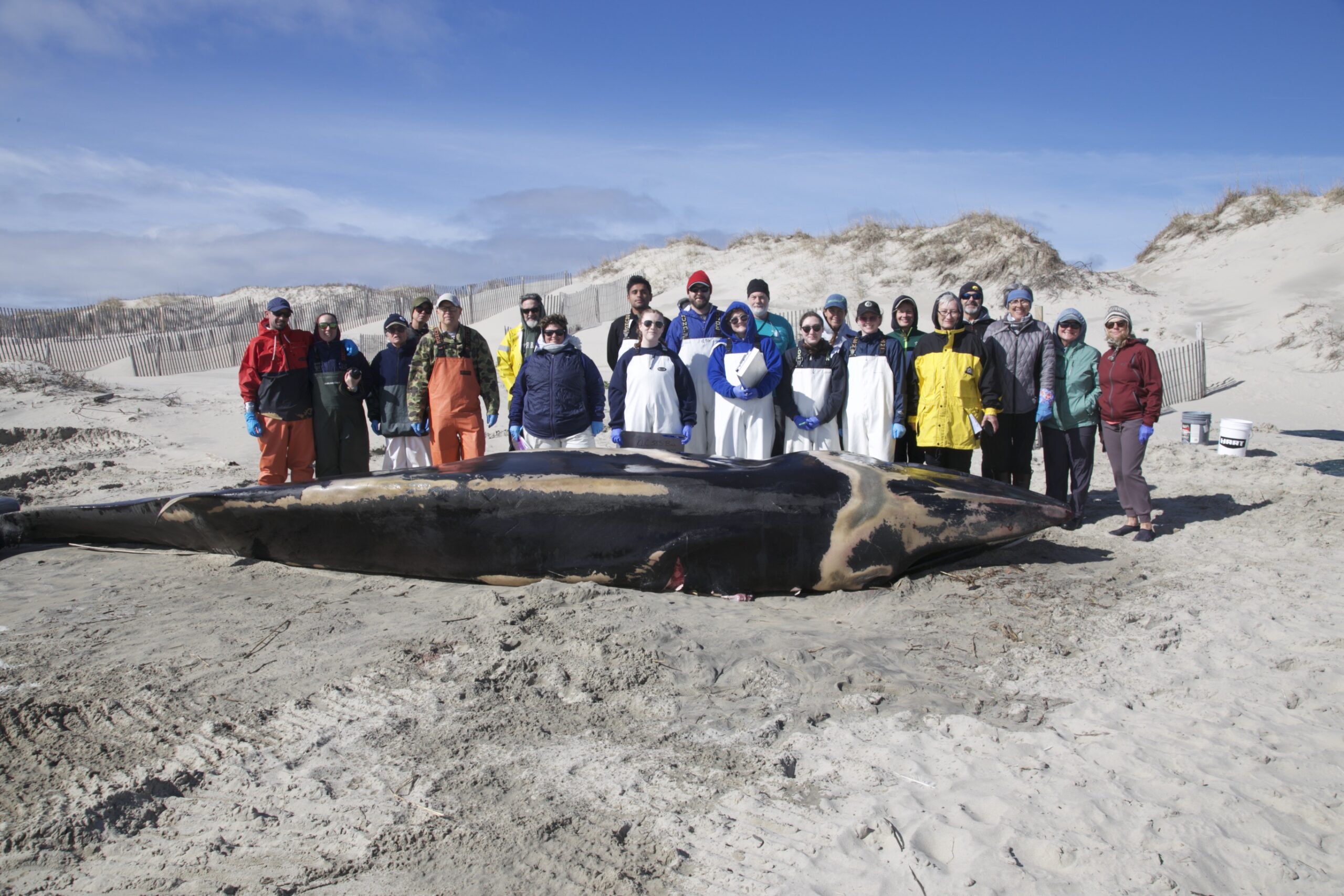
The N.C. Marine Mammal Stranding Network is a multi-institutional collaborative partnership of scientists, researchers, and stranding personnel who respond to and necropsy stranded marine mammals.
Hotlines
- Northern Coast: 252-455-9654
- Central Coast: 252-241-5119
- Southern Coast: 910-515-7354

How to Report
To report a live or dead stranded marine mammal (dolphin, whale, seal, manatee) in your area, please call the appropriate hotline number listed above. When possible, include:
- Number of animal(s) involved
- Condition of animal(s)
- Location of the animal(s) (GPS or address)
- Identification, description, or photo of the animal
- Date and time of observation
- Name and telephone number of person reporting
NOTE: Seals are visitors to our shores throughout the year and will sometimes hail out on land to rest. This is natural behavior. Please stay 150+ feet away from seals in the wild, and call a hotline to report.
Frequently Asked Questions
Why do marine mammals strand?
Marine mammals strand for a variety of reasons: they may strand due to anthropogenic causes, including vessel strikes, debris entanglement, ingestion of debris, pollution exposure, human disturbance or harassment, or a combination of these. They also strand due to natural causes such as infectious diseases (bacterial or viral), non-infectious diseases such as cancer, harmful algal blooms, predation, old age, or intra- or interspecific blunt force trauma.
Why does North Carolina have a marine mammal stranding program?
We investigate and track marine mammal strandings and causes of these events to understand health trends such as impacts of climate change, emerging diseases, and anthropogenic effects. We strive to minimize suffering of live stranded marine mammals when possible, and reduce risks to public health, such as disease transmission, or bites. Information we collect from stranded animals informs conservation and management efforts, particularly concerning pelagic species, such as beaked whales, and pygmy and dwarf sperm whales. Data we collect provides foundational information about the frequency and location of fisheries and vessel interactions. These data may provide evidence for agency policy and regulations such as gear modifications, speed restrictions, and time-area closures.
At least 33 species of whales, dolphins and porpoises strand on North Carolina beaches. This impressive variety of species is due to the confluence of cold Virginia Current waters and the warm Gulf Stream off the coast, and the proximity of the inner and outer continental shelves to the coastline. These strandings are more frequent from October through May, although strandings occur every month of the year. Stranded marine mammals are found on ocean beaches and sounds, in estuaries and along river banks. Three species of seals are found mostly in colder months on North Carolina beaches. Seals haul out on NC beaches to rest. We monitor them, and provide a barrier to keep the public (and dogs) away while allowing an obstruction-free path to the ocean. Manatees are reported both live and stranded in North Carolina sounds and estuaries mostly during summer and early fall months. Water temperatures below 20 d Celsius (68 d Fahrenheit), pose a threat to manatees (Cold Stress Syndrome).
If you see a live manatee:
What is the difference between a porpoise and a dolphin?
Dolphins have prominent, elongated “beaks” or rostrums, cone-shaped teeth, falcate dorsal fins, are larger, and live longer than porpoises. Porpoises have no beaks, spade-shaped teeth, and triangular shaped dorsal fins. Bottlenose dolphins reach sexual maturity between 6-10 years of age. Females give birth every 2-3 years and may live into their 60’s, males can live into their 50’s. Harbor porpoises, the only porpoise that occurs in North Carolina waters, reaches sexual maturity between 2-3 years of age, and females give birth every 1-2 years. Harbor porpoises live into their late teens. Harbor porpoises have thick blubber and smaller appendages, reducing their surface area to volume ratio, and losing less heat in the cold waters they frequent.

In the News


Central Coast Stranding Team


Partners
North Carolina’s coastline comprises a vast system of barrier islands, sounds, rivers, and wetlands. Along the southeastern Atlantic coast of the United States, NC is second only to Florida in the number of marine mammals that strand each year. With such an extensive shoreline, many groups spring into action when marine mammals strand in coastal and estuarine environments. Stranding response in NC is divided into three geographic areas: northern, central, and southern.
In the northern area, the coastal sections of Currituck, Dare, and Hyde counties are the responsibility of the NC Wildlife Resources Commission (NCWRC), NC Aquarium on Roanoke Island (NCARI) and Jennette’s Pier (JPIER), and Cape Hatteras National Seashore (CHNS).
In the central coastal and northern inland areas, the North Carolina Aquarium at Pine Knoll Shores Marine Mammal Stranding Team is responsible for stranding response. This central area includes counties surrounding the Albemarle Sound (Camden, Pasquotank, Perquimans, Chowan, Bertie, Washington, Tyrrell, inland Dare), most counties surrounding the Pamlico Sound (Hyde, Beaufort, Pamlico, and Carteret), and central coastal counties (Carteret, Craven, and the northern half of Onslow). The central coast stranding team works closely with NC State Center for Marine Sciences and Technology (CMAST), NC State College of Veterinary Medicine (CVM), Bonehenge Whale Center, NC Maritime Museum, Cape Lookout National Seashore (CLNS), state parks (Fort Macon and Hammock’s Beach), local marine labs (Duke University Marine Lab and UNC Institute of Marine Sciences) and the NCWRC.
The southern area includes the southern portion of Onslow County and all of Pender, New Hanover, and Brunswick counties; coastal and inland portions of this area are the primary responsibility of The University of North Carolina Wilmington Marine Mammal Stranding Program.
Select Publications
Strandings as indicators of marine mammal biodiversity and human interactions off the coast of North Carolina
Documenting the bycatch of harbor porpoises, Phocoena Phocoena, in coastal gillnet fisheries from stranded carcasses
Spatial and temporal patterns of habitat use and mortality of the Florida manatee (Trichechus manatus latirostris) in the Mid-Atlantic States of North Carolina and Virginia from 1991 to 2012
Abundance and sighting patterns of bottlenose dolphins (Tursiops truncatus) at four northwest Atlantic coastal sites
Low residue euthanasia of stranded Mysticetes.
Bronchoalveolar lavage in a dolphin
Off-road vehicle and pedestrian track effects on the sea-approach of hatchling loggerhead turtles
Hosier. P.E., M. Kochhar, and V. G. Thayer. 1981. Off-road vehicle and pedestrian track effects on the sea-approach of hatchling loggerhead turtles. Environmental Conservation 8.2 :158-161.
Meningeal lymphatic and glymphatic structures in a pelagic delphinid (Delphinus delphis)
Stingray spine mortality in a bottlenose dolphin, Tursiops truncatus, from NC waters
Anthropogenic contaminants and histopathological findings in stranded cetaceans in the southeastern United States
Blue whale (Balaenoptera musculus) distribution in the eastern tropical Pacific
Reilly, S.B. and V. G. Thayer. 1990. Blue whale (Balaenoptera musculus) distribution in the eastern tropical Pacific. Marine Mammal Science. 6: 265-277.
A call to rename Ziphius cavirostris the goose-beaked whale: promoting inclusivity and diversity in marine mammalogy by re-examining common names
Reproductive seasonality of western Atlantic bottlenose dolphins off North Carolina, USA
A North Carolina stranding of a white-beaked dolphin, Lagenorhynchus albirostris, Family Delphinidae, most southerly record
Thayer VG, Harms CA, Rittmaster KA, Rotstein DS, Hairr JE. 2018. A North Carolina stranding of a white-beaked dolphin, Lagenorhynchus albirostris, Family Delphinidae, most southerly record. Aquat Mamm 44: 32-38. DOI 10.1578/AM.44.1.2018.32
Stock Identity of Stranded Tamanend’s Bottlenose dolphins (Tursiops erebennus) With Evidence of Fisheries Interaction in Virginia, North Carolina, and South Carolina
Urian, K. W., Barco, S. G., Clark, K.L., Costidis, A. M., Doskov, P., Piscitelli-Doshkov, M. Epple, A. L., Keenan, T.F., McLellan, W. A., McFee, W. E., Pabst, D. A., Rittmaster, K. A., Speakman, T. R., Thayer, V. G., Read, A. J. 2026. Stock Identity of Stranded Tamanend’s Bottlenose dolphins (Tursiops erebennus) With Evidence of Fisheries Interaction in Virginia, North Carolina, and South Carolina. Marine Mammal Science, 42: e707147 https://doi.org/10.10111/mms.70147